


Which Diamond Belt Is Best for Tungsten Carbide Coating Grinding
Electroplated and Resin Diamond Belts for Carbide Coatings
Grinding and finishing tungsten carbide and other hard thermal spray coatings can be challenging because of their high hardness, coating structure and demanding surface-finish requirements. Diamond abrasive belts are widely used for processing hard and brittle materials, and both electroplated diamond belts and resin-bonded diamond belts can be considered depending on the grinding stage and required surface finish.
The key difference is not simply the diamond abrasive itself. The bonding system, abrasive distribution, belt flexibility, grinding parameters and application stage can all affect the resulting performance.
This guide explains the structural differences between electroplated and resin diamond abrasive belts and provides a practical framework for selecting a diamond belt for carbide coating grinding and finishing.
Why Diamond Belts Are Used for Carbide Coatings
Tungsten carbide and other carbide-based thermal spray coatings are commonly used where high resistance to abrasion, erosion and wear is required. Depending on the coating process and material system, the sprayed surface may require subsequent grinding or finishing to achieve the required dimensional accuracy and surface condition.
For example, Saint-Gobain’s carbide thermal spray materials are designed for applications requiring abrasion, erosion and sliding-wear resistance, and the manufacturer specifies that some carbide coatings can be finished using diamond grinding.
Diamond abrasive is particularly suitable for difficult-to-grind materials because of its high hardness and cutting capability. Research on diamond abrasive belt grinding has also demonstrated its application to hard and brittle composite materials, including SiC-based materials.
Electroplated Diamond Belt Construction
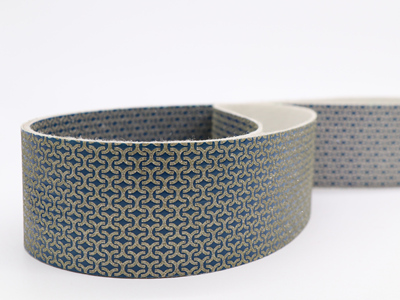
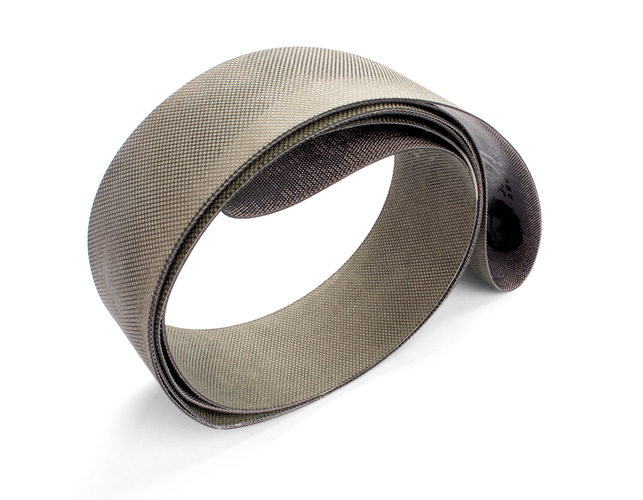
An electroplated diamond abrasive belt uses an electroplated metal layer to retain diamond grains on the belt backing. The diamond grains are exposed at the working surface and are mechanically retained by the plated layer.
This construction provides a relatively high abrasive exposure and allows the belt to provide aggressive cutting action. Research on electroplated diamond abrasive belts has investigated how abrasive grain size, chip-clearance design, backing thickness and coating parameters influence grinding performance.
One important characteristic of abrasive belts is that the abrasive layer can wear through grain fracture, attrition and grain pull-out. A study of electroplated diamond abrasive belts found that wear evolution is closely related to the grinding process and workpiece material.
Resin Diamond Belt Construction
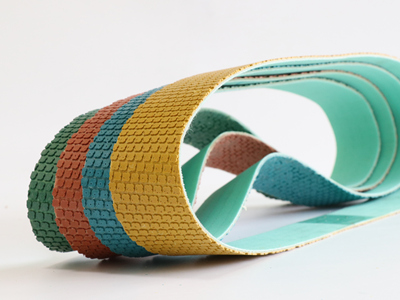
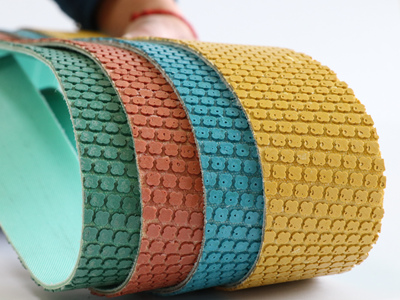
A resin-bonded diamond abrasive belt uses a resin-based bonding system to retain diamond abrasive on a flexible backing. Compared with a rigid grinding wheel, the flexible belt structure allows the abrasive tool to conform more readily to the workpiece geometry and contact conditions.
The behavior of a resin-bonded diamond tool is strongly influenced by the bond formulation, abrasive concentration, particle size, backing and grinding parameters. Therefore, resin diamond belts should not be evaluated only by the word “resin”; the complete abrasive-bond system determines the actual performance.
Research comparing resin-bonded and plated diamond grinding tools has shown that bond material can influence grinding force, grinding temperature and surface finish. In that study, the resin-bonded diamond tool produced better surface finish under the tested conditions.
Electroplated Diamond Belt Performance for Carbide Coatings
Electroplated diamond belts can be a strong option when the process requires relatively aggressive abrasive action and efficient stock removal.
The exposed diamond grains provide direct contact with the workpiece, while the belt’s flexible structure allows grinding to be performed on cylindrical, contoured or other geometries where a conventional rigid grinding wheel may not be the most convenient solution.
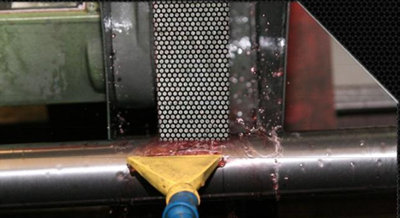
Industrial application data also demonstrate the use of flexible diamond belts for finishing hard thermal spray coatings. For example, diamond belt grinding has been demonstrated for HVOF tungsten carbide-coated cylinders using separate stock-removal and finishing conditions.
However, the actual material removal rate depends on factors such as:
- Diamond grit size
- Diamond concentration and distribution
- Belt speed
- Contact pressure
- Workpiece speed and feed
- Contact wheel characteristics
- Coolant conditions
- Coating composition and thickness
Published research on electroplated diamond belts confirms that belt speed, grinding pressure and belt tension can significantly influence material removal rate and surface roughness.
Resin Diamond Belts for Fine Grinding and Finishing
When the process moves from stock removal toward surface finishing, a resin-bonded diamond belt may be considered because the flexible bond system can provide different contact and finishing characteristics.
Experimental research comparing plated and resin-bonded diamond grinding tools found that the resin-bonded tool achieved better surface finish under the investigated conditions. However, this should not be interpreted as a universal result for every resin and electroplated belt. Belt formulation, abrasive size and grinding parameters can significantly change the outcome.
For this reason, resin diamond belts are often evaluated when the primary objective changes from maximum stock removal to controlled finishing and surface-quality improvement.
Electroplated or Resin Diamond Belt for Carbide Coating Grinding?
There is no universal answer. The better belt depends on what the process is trying to achieve.
| Processing Requirement | Potential Choice | Reason to Consider |
|---|---|---|
| High stock removal | Electroplated diamond belt | High abrasive exposure and direct cutting action |
| Grinding hard thermal spray coatings | Electroplated diamond belt | Suitable for aggressive grinding applications |
| Fine grinding | Resin diamond belt | Flexible bond characteristics can support finishing applications |
| Surface finish improvement | Resin diamond belt | Can provide different contact and finishing behavior |
| Complex or curved surfaces | Flexible diamond belt | Flexible abrasive belt adapts to the contact geometry |
| Multi-stage processing | Combination of belt types | Different belts can be selected for different grinding stages |
Electroplated Diamond Belt for Rough Grinding
For a carbide coating with a relatively large machining allowance, the first objective is normally to remove excess coating efficiently while maintaining control of the workpiece temperature and geometry.
Electroplated diamond belts are worth evaluating at this stage because their abrasive grains are directly exposed at the working surface. Research on electroplated diamond abrasive belts has shown that abrasive structure and process parameters have a significant effect on material removal behavior.
For production applications, the belt should be selected according to the coating composition, coating thickness, required stock removal and available machine parameters rather than choosing grit size alone.
Resin Diamond Belt for Fine Grinding and Polishing
After the major coating allowance has been removed, the process may shift toward reducing grinding marks and improving surface quality.
At this stage, a finer diamond abrasive and a suitable resin-bonded belt can be evaluated. Published comparative research shows that bond selection can influence surface finish, grinding force and temperature, demonstrating why abrasive-bond selection is an important part of process optimization.
The appropriate grit size should be determined by the initial surface condition, target roughness and the amount of material that must be removed in the finishing stage.
A Multi-Stage Diamond Belt Process Can Be More Practical
For carbide coating applications, it is often more useful to think in terms of process stages rather than trying to make one belt perform every operation.
A typical process-development approach may be:
- Stock removal: select a diamond belt capable of efficiently removing the coating allowance.
- Intermediate grinding: reduce the grinding marks left by the previous operation using a finer abrasive.
- Fine finishing: use an appropriate fine-grit diamond belt when lower surface roughness is required.
- Final inspection: evaluate surface roughness, dimensional accuracy, coating integrity and belt wear.
The exact grit sequence and grinding parameters should be established through application testing because the optimum combination depends on the coating, machine, contact wheel, workpiece geometry and target surface finish.
How to Select a Diamond Abrasive Belt for Carbide Coatings
1. Identify the Coating Material
Start with the actual coating chemistry. Tungsten carbide, chromium carbide and other carbide-containing coatings can have different structures and grinding characteristics.
Do not select the abrasive belt based only on the hardness value. Coating porosity, binder phase, deposition method, thickness and surface condition can also influence grinding behavior.
2. Determine the Machining Allowance
A larger allowance generally requires a process capable of higher material removal. If the allowance is already small, the priority may instead be surface finish and dimensional control.
3. Define the Target Surface Roughness
The target roughness should determine the finishing strategy. A coarse belt intended for stock removal should not automatically be expected to produce the same surface condition as a fine finishing belt.
4. Check the Machine and Contact Wheel
Abrasive belt performance depends not only on the belt itself. Belt speed, tension, contact wheel hardness, contact geometry, feed rate and applied pressure can all affect the grinding result.
Published research on electroplated diamond belts confirms that belt speed, grinding pressure and belt tension can influence both material removal and surface roughness.
5. Evaluate Cooling Conditions
Cooling requirements should be determined from the belt construction, workpiece material, grinding load and machine conditions. It is not appropriate to classify every resin diamond belt as universally suitable for dry grinding or every electroplated belt as requiring wet grinding.
Instead, the cooling method should be validated through application testing to control grinding temperature and prevent damage to the coating or workpiece.
Common Problems When Grinding Carbide Coatings with Diamond Belts
Low Material Removal Rate
Check the diamond grit size, abrasive exposure, belt speed, contact pressure and belt condition. A belt that is too fine for the required stock removal may reduce productivity.
Excessive Grinding Marks
Check whether the abrasive is too coarse for the required finish. A finer finishing step may be necessary after stock removal.
Rapid Belt Wear
Inspect the grinding load, belt tension, cooling conditions and workpiece coating characteristics. Abrasive belt wear is affected by both the abrasive and the grinding conditions. Research on electroplated diamond belts has identified grain fracture, wear and grain pull-out as important wear mechanisms.
Surface Quality Is Inconsistent
Check belt tracking, contact wheel condition, workpiece speed, feed rate, belt tension and coolant delivery. Process stability is just as important as abrasive selection.
Why Work with a Diamond Abrasive Belt Manufacturer?
Choosing a diamond belt by grit size alone is rarely enough for carbide coating grinding.
The belt specification may need to be matched to the coating material, coating thickness, machining allowance, workpiece geometry, machine type, contact wheel, belt speed, grinding pressure, cooling method and target surface roughness.
As a diamond abrasive belt manufacturer, we can help evaluate the appropriate diamond grit, belt construction, abrasive concentration and dimensions according to the actual application.
Looking for a diamond abrasive belt for tungsten carbide, chromium carbide or HVOF thermal spray coating? Send us your coating material, workpiece dimensions, current belt specification, grinding allowance and target surface roughness. We can recommend a suitable diamond belt for application testing.
Next:
This is already the latest article


