


CBN Segment Solutions for Motorcycle Brake Disc Grinding
Motorcycle brake discs require controlled grinding of their friction surfaces to achieve consistent thickness, surface condition and dimensional accuracy. In high-volume motorcycle brake disc production, the grinding tool must also maintain stable cutting performance and predictable service life.
CBN segments are used as part of the grinding wheel system for brake disc grinding, particularly where controlled stock removal, surface quality and production consistency are important.
For manufacturers using double-disc or dedicated brake disc grinding machines, the performance of the CBN segment directly affects grinding stability, tool life and the consistency of the finished brake disc.
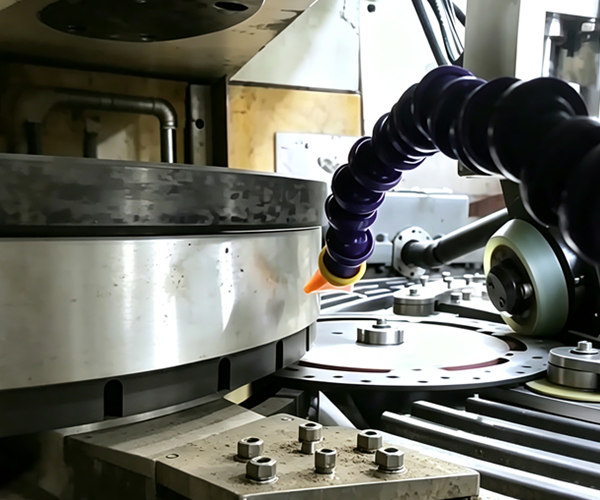
CBN Segments in Brake Disc Grinding Machines
Motorcycle brake discs can be processed on dedicated surface grinding equipment, including vertical and horizontal double-disc grinding machines. In these systems, the brake disc is positioned between opposing grinding wheels, allowing the two friction surfaces to be ground in a controlled production process.
Fives, for example, describes vertical double-disc grinding solutions specifically for brake disc applications and lists CBN and diamond grinding wheel segments among the available wheel solutions. Its brake disc grinding systems are designed for high-precision surface grinding and high-production applications.
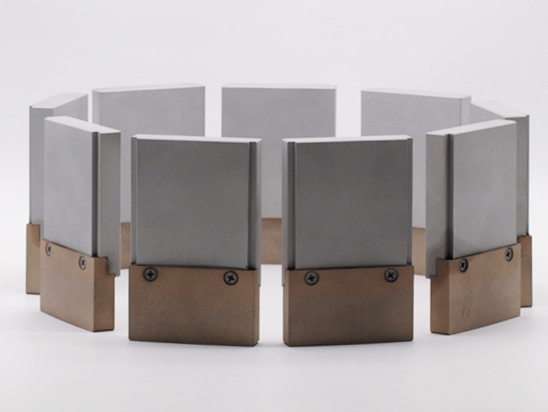
Multiple CBN segments can be mounted around the grinding wheel according to the wheel design, segment dimensions and machine configuration. The exact number and arrangement of segments are therefore determined by the grinding wheel system rather than by the brake disc alone.
This means that replacing or optimizing CBN segments requires consideration of the existing grinding wheel configuration, not simply the selection of a CBN grit size.

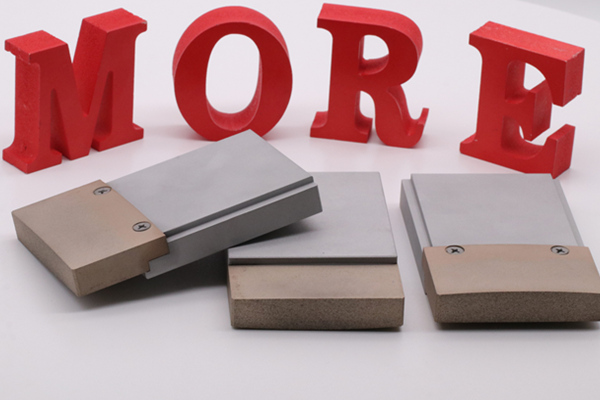
Why CBN Segment Performance Matters in Motorcycle Brake Disc Grinding
In brake disc production, grinding performance needs to remain stable throughout the production cycle. Problems with the grinding segments can result in inconsistent stock removal, changing surface condition or shortened tool life.
Typical problems that manufacturers may encounter include:
— CBN segments wearing too quickly
— Unstable stock removal during production
— Inconsistent surface finish
— Grinding performance decreasing as the wheel is used
— Uneven wear between grinding segments
— Tool life below the production target
— Replacement segments that do not match the existing grinding wheel
— Difficulty maintaining dimensional consistency between batches
In brake disc grinding, the segment should not be selected by CBN grit size alone. Brake disc material, hardness, grinding allowance, surface requirements, machine conditions and grinding wheel configuration all need to be considered together. The objective is not simply to use a harder or finer abrasive. The objective is to develop a CBN segment specification that provides the required balance between cutting ability, wear behavior, surface quality and service life.
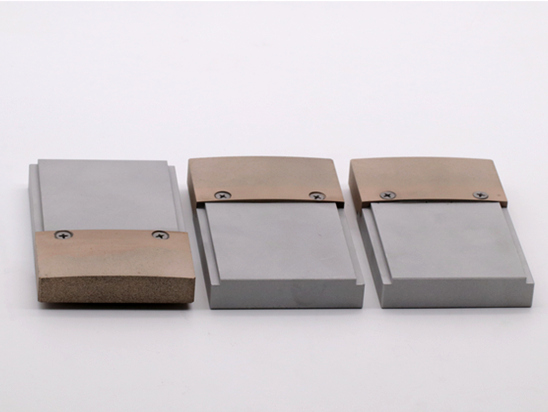
How to Select CBN Segments for Brake Disc Grinding
1. Match the CBN Segment to the Brake Disc Material
The brake disc material is one of the first factors to consider when selecting a CBN segment. Different materials can have different grinding behavior, hardness and requirements for abrasive performance.
For example, cast iron, alloy steel and other brake disc materials should not automatically be assigned the same CBN segment specification.
Moresuperhard CBN segments for brake disc grinding can be manufactured for applications involving cast iron, carbon composite materials and high-alloy steel. The appropriate specification depends on the actual workpiece material and grinding conditions rather than the application name alone.
For a new application, it is therefore important to provide the material grade and hardness together with the brake disc dimensions.
| Parameter | Why It Matters |
|---|---|
| Brake disc material | Influences abrasive cutting behavior and segment wear |
| Material hardness | Helps determine the required segment performance |
| Brake disc diameter | Relates to the grinding wheel and machine configuration |
| Grinding allowance | Determines the required stock removal capability |
| Surface finish requirement | Influences the overall grinding specification |
CBN Grit and Bond Selection for Brake Disc Grinding
CBN grit size and bond type are important parts of segment design, but they should be selected together with the application requirements.
CBN Grit Size
CBN grit size influences the cutting characteristics of the segment and should be considered in relation to stock removal and surface requirements.
Coarser grit specifications may be considered where higher cutting performance is required, while finer grit specifications may be considered when the grinding process places greater emphasis on surface condition.
However, there is no single CBN grit size that is universally suitable for all brake disc grinding applications. The correct choice depends on the material, grinding allowance, machine parameters, wheel design and required finish.
Bond System
The bond holds the CBN abrasive grains in the segment and affects how the abrasive is exposed and how the segment behaves during grinding.
Depending on the application, CBN segments may use different bond systems, including resin and metal bond configurations.
The bond selection should take into account the required cutting behavior, wear characteristics, grinding conditions and expected service life.
For this reason, a brake disc grinding segment should be treated as a complete abrasive system rather than simply a block of CBN abrasive.
Application Example: CBN Segments for Motorcycle Brake Disc Grinding
The following example is based on an actual brake disc grinding project and is provided to demonstrate how a CBN segment specification can be developed around a specific application.
| Item | Application Data |
|---|---|
| Application | Motorcycle brake disc grinding |
| Brake disc diameter | 190–300 mm |
| Material | SUS 410M |
| Hardness | 35 HRC ±3 |
| Segment size | D70 × W17 × H42 × L122 mm |
| CBN grit | CBN140 |
| Total segments | 36 |
| Upper grinding wheel | 18 segments |
| Lower grinding wheel | 18 segments |
| First-pass stock removal | 0.20–0.27 mm |
| Final-pass stock removal | 0.03 mm |
| Grinding width | Mainly 32 mm, some 50 mm |
In this application, the workpiece material was SUS 410M with a hardness of 35 HRC ±3. The CBN segment specification was CBN140, with a segment size of D70 × W17 × H42 × L122 mm.
The grinding wheel system used a total of 36 segments. The upper grinding wheel contained 18 segments and the lower grinding wheel contained another 18 segments.
The grinding process included a first-pass stock removal of 0.20–0.27 mm followed by a final-pass stock removal of 0.03 mm. The main grinding width was 32 mm, with some 50 mm applications.
This example demonstrates why the CBN segment should be specified according to the complete application. The segment dimensions, CBN grit, segment quantity, workpiece material and stock removal were all considered together.
These parameters should be treated as application-specific data, not as a universal specification for motorcycle or automotive brake discs.
CBN Segment Configuration for Double-Disc Grinding
In a double-disc grinding system, the relationship between the upper grinding wheel, lower grinding wheel and workpiece is an important part of the process.
Both grinding wheels need to work in a coordinated manner to achieve the required surface condition and dimensional accuracy. Segment quantity and arrangement therefore need to match the grinding wheel design and machine configuration.
For example, Fives’ published brake disc grinding documentation describes configurations using CBN or diamond grinding wheel segments and identifies segment quantities for specific machine designs. One published configuration uses 24 segments on each wheel, or 48 segments in total.
This illustrates an important point: segment count is application- and wheel-specific. A different grinding wheel design can use a different number, size or arrangement of segments.
For replacement segments, the existing wheel drawing or segment configuration should therefore be checked before production.
CBN Segments for Brake Disc Grinding from Moresuperhard
Moresuperhard manufactures CBN segments for brake disc grinding and other precision grinding applications.
Our brake disc grinding CBN segments are available with different abrasive and bond specifications according to the application. Current product configurations include resin and metal bond options and CBN grit ranges such as 80#–240#, with applications covering cast iron, carbon composite materials and high-alloy steel brake discs.
For replacement applications, we can manufacture segments according to customer drawings and existing grinding wheel configurations.
Whether you need standard CBN segments for brake disc grinding or replacement segments matched to an existing grinding wheel, providing the workpiece material, hardness, segment drawing, grinding allowance and machine information allows us to evaluate the application more accurately.
Request a Custom CBN Segment for Brake Disc Grinding
Looking for replacement CBN segments for your brake disc grinding wheel?
Send us your segment drawing, dimensions, brake disc material, hardness, stock removal, grinding wheel configuration and machine information. Our team can evaluate the requirements and provide a customized CBN segment solution.
Contact Moresuperhard for CBN segments for brake disc grinding.


