


Valve Plate Double Disc Grinding for Precision Surface Finishing
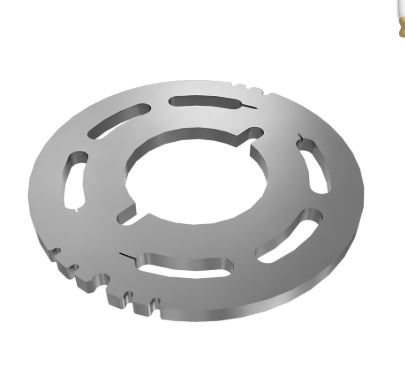
Valve plates require more than simply removing material from two surfaces. For manufacturers of compressor, hydraulic, pneumatic, and other precision valve components, the grinding process must control thickness, flatness, parallelism, total thickness variation (TTV), and surface finish while maintaining a stable production cycle.
When these requirements become difficult to achieve with conventional surface grinding or sequential face grinding, double disc grinding provides a way to process both opposing faces in the same grinding operation.
MORESUPERHARD manufactures customized diamond and CBN double disc grinding wheels for valve plates and other precision flat components, with wheel specifications developed according to the workpiece material, hardness, stock removal, machine, coolant, and required final quality.
Grinding Requirements for Valve Plates
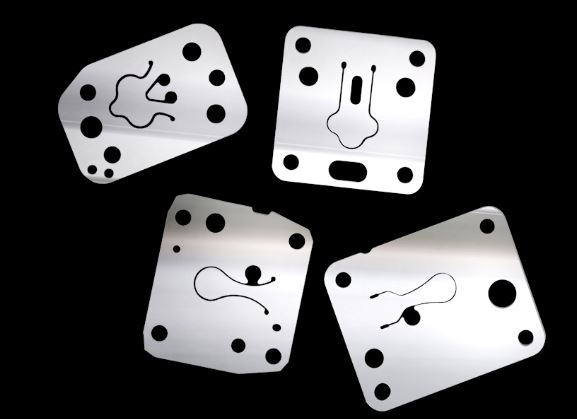
The grinding requirements of a valve plate depend heavily on its material, casting or machining condition, thickness tolerance, and final sealing or assembly requirements.
For manufacturers looking for a grinding wheel, the key question is not simply whether a wheel can grind the material. The more important question is whether the wheel can remove the required stock while maintaining the geometry and surface quality of the valve plate throughout production.
Typical requirements may include:
— Controlled final thickness
— High parallelism between both faces
— Low flatness deviation
— Low total thickness variation (TTV)
— Consistent surface roughness
— Stable stock removal
— Short and repeatable cycle time
— Low risk of grinding burn
— Consistent wheel performance over production runs
For valve plates, these requirements are closely related. Increasing stock removal, changing the material condition, or using an unsuitable wheel specification can affect grinding forces, wheel wear, surface finish, and dimensional stability.
This is why the double disc grinding wheel needs to be selected around the actual valve plate grinding process, rather than only according to wheel diameter or abrasive type.
Why Use Double Disc Grinding for Valve Plates?
A valve plate normally has two opposing faces that need to maintain a controlled relationship with each other.
With double disc grinding, the upper and lower grinding wheels process the two faces simultaneously. This makes the process particularly relevant when manufacturers need to control the relationship between the two ground surfaces while maintaining production efficiency.
For valve plate manufacturers, the potential benefits include:
Simultaneous Grinding of Both Faces
Both surfaces are processed during the same grinding cycle instead of completing the two faces in separate operations.
This can reduce the need to repeatedly reposition the component between face-grinding operations.
Better Control of Thickness and Parallelism
Because the two faces are ground within the same process, the grinding system can be configured around the required final thickness and parallelism.
For precision valve plates, this is particularly important when both faces must remain closely controlled after grinding.
Higher Production Efficiency
Double disc grinding is suitable for production environments where many similar components must be processed repeatedly.
The process can combine relatively high material removal with controlled finishing in a single grinding operation, depending on the machine configuration and wheel specification.
Consistent Surface Finish
The grinding wheel must be selected not only for material removal but also for the required final surface condition.
A properly developed wheel specification can balance cutting ability, wheel wear, dressing behavior, and surface finish.
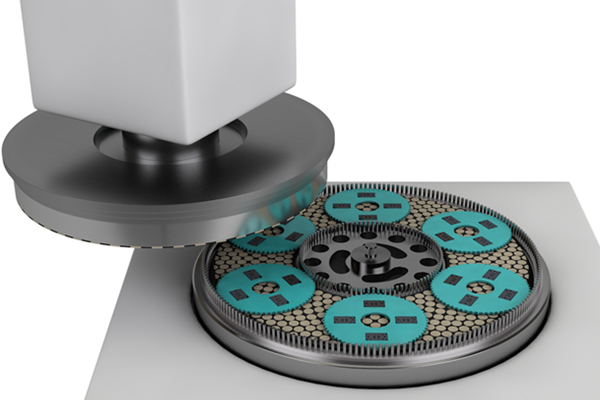
double disc grinding valve plate
Valve Plate Grinding Case Study
MORESUPERHARD developed a double disc grinding wheel solution for CR2 steel valve plates processed on a LAPMASTER DSG720.
The workpieces had a diameter of 120 mm and a hardness of 20 HRC. The components came from a casting pre-finishing process and required 0.12–0.15 mm stock removal during grinding.
The production target was a cycle time of less than three minutes. Oil was used as the coolant.
Workpiece and Grinding Conditions
| Parameter | Value |
|---|---|
| Workpiece | Valve Plate |
| Material | CR2 Steel |
| Hardness | 20 HRC |
| Diameter | Ø120 mm |
| Previous Process | Casting |
| Stock Removal | 0.12–0.15 mm |
| Coolant | Oil |
| Required Cycle Time | <3 minutes |
| Machine | LAPMASTER DSG720 |
The grinding machine used 5.5 kW power for both the upper and lower grinding discs, with a 3 kW center spindle.
Grinding Results
Before finish grinding, the surface roughness was approximately 6 Rz.
After grinding, the valve plates achieved:
| Grinding Result | Result |
|---|---|
| Surface Roughness | 3 Rz |
| Flatness | 0.002 mm |
| Parallelism | <0.004 mm |
| TTV | <0.001 mm |
| Cycle Time | <3 minutes |
The process therefore addressed several requirements simultaneously: material removal, surface finish, flatness, parallelism, thickness variation, and production cycle time.
Choosing Diamond or CBN for Valve Plate Grinding
The abrasive should be selected according to the valve plate material and grinding conditions.
For ferrous steel valve plates, CBN is often considered for precision grinding applications. For other hard or difficult-to-grind materials, diamond may be more appropriate.
However, abrasive type is only one part of wheel selection.
A suitable double disc grinding wheel may also require optimization of:
— Grit size
— Bond type
— Concentration
— Wheel structure
— Segment configuration
— Wheel dimensions
— Grinding speed
— Coolant
— Dressing conditions
For this reason, a valve plate manufacturer should provide the wheel supplier with the actual workpiece and process information rather than ordering a wheel based only on the workpiece material.
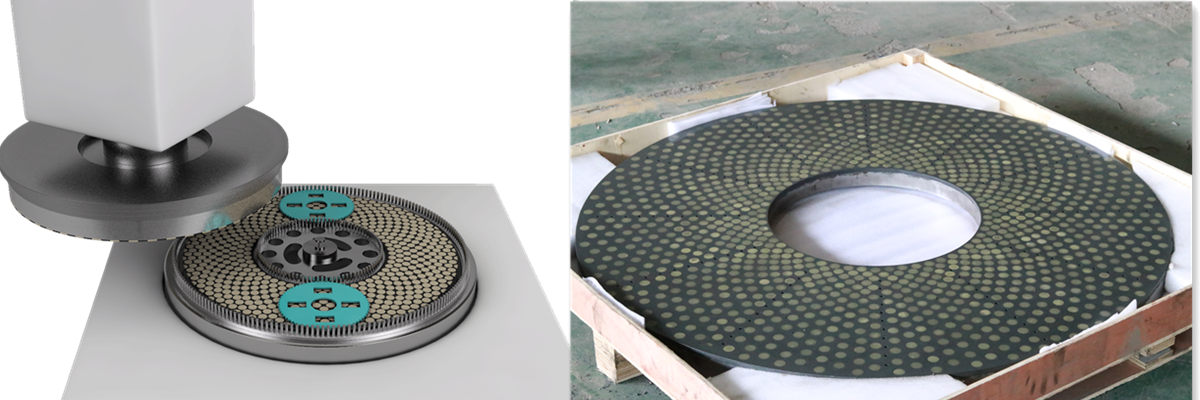
Double Disc Grinding Wheels for Different Valve Plate Materials
Although the case above focuses on CR2 steel, valve plates and similar flat components can involve different material conditions. Wheel specifications may need to change based on the material and grinding requirements.
Steel Valve Plates
Focus on CBN wheel selection, controlled material removal, dimensional stability, and surface finish.
Hardened Steel Components
Wheel selection needs to consider hardness, grinding force, heat generation, and required finishing accuracy.
Carbide Components
Diamond grinding wheels are generally considered for carbide because of diamond’s suitability for grinding hard non-ferrous materials.
Ceramic Components
Diamond wheels can be used for hard, brittle ceramic materials, with wheel specification developed around the required removal rate and surface finish.
Therefore, there is no single “standard double disc wheel” that is optimal for every workpiece.
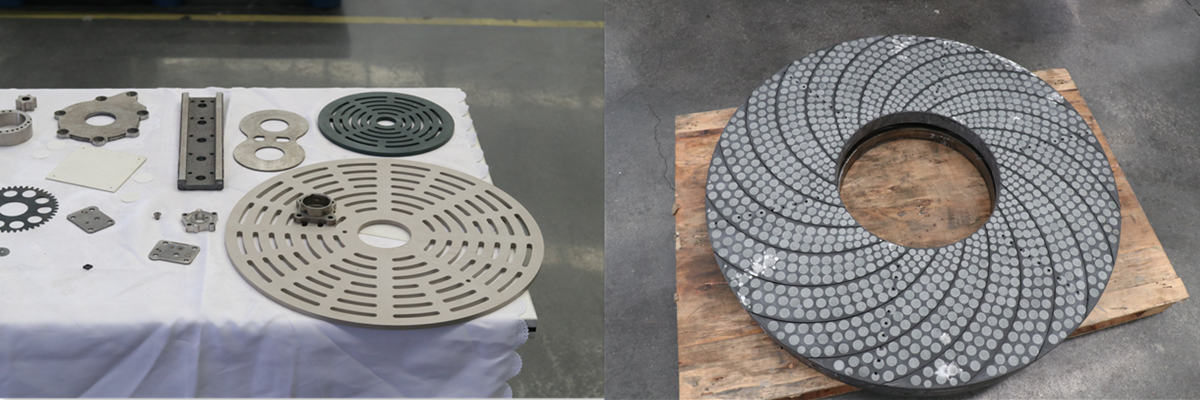
Customized Double Disc Grinding Wheels for Your Workpiece
MORESUPERHARD supplies diamond and CBN double disc grinding wheels for precision grinding applications.
Wheel specifications can be customized according to the customer’s:
— Workpiece material
— Workpiece dimensions
— Stock removal
— Surface finish requirement
— Flatness and parallelism requirement
— Machine model
— Coolant
— Grinding process
— Production cycle time
Available bond options include resin and vitrified bonds, with customized wheel dimensions, grit sizes, and configurations for double disc grinding machines including LAPMASTER, Peter Wolters, Wendt, DISKUS, and other systems.
The goal is not simply to supply a grinding wheel. It is to develop a wheel specification around the actual workpiece and grinding conditions.
Looking for a Double Disc Grinding Wheel for Valve Plates?
If you are grinding steel valve plates or other precision flat components and are experiencing problems with thickness variation, parallelism, flatness, surface finish, wheel wear, or cycle time, send us your current grinding information.
Please provide:
Workpiece material + hardness + dimensions + stock removal + required thickness + flatness/parallelism + surface roughness + machine model + current wheel specification
MORESUPERHARD can evaluate the application and recommend a suitable diamond or CBN double disc grinding wheel for rough grinding, finish grinding, or a combined grinding process.
—EDITOR: Doris Hu, Julia Zhang
—-POST: Doris Hu
Next:
This is already the latest article


